
FacebookMySpaceiTunesYou Tube

Peter Cooper On Music: John Hiatt's passion hasn't dimmed

Posted on September 8, 2011 by Peter Cooper
Website

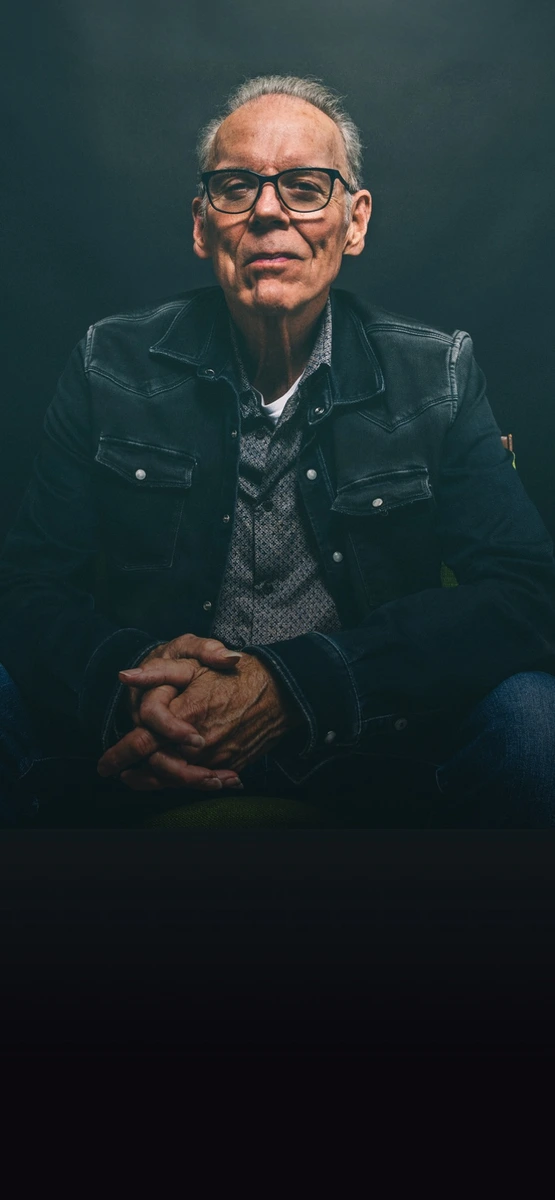
john hiattIt's supposed to get harder.

Not at first, when a fledgling songwriter is struggling to understand the intricacies of melody and meter, and working to pack away enough life experience to find something valuable and wise to say. It's supposed to get easier from there, for a while.

But after that, creation is supposed to become labored. Think of your longstanding favorite recording artists. Isn't the latest album the one with the songs that send folks in the crowd to the concession stands?

Isn't "I prefer his earlier work" the norm?

What's your favorite Rolling Stones record? Let me guess. ... It's not A Bigger Bang. (A note: Released in 2005, A Bigger Bang has some phenomenal songs on it, including "Rough Justice." But it's not your favorite. Beggars Banquet, from 1968, is.)

"How much longer can my brain set itself on fire?" sings John Hiatt, the Music City Walk of Fame member who has been writing and performing searing works of merit and consequence since before he arrived in Music City, 40 years ago.

Valid point, the fire deal. Most of us have a few go-to stories we can tell. Hiatt has hundreds of those stories, and they all need to rhyme, and to entertain, and to have moments of surprise and open-heartedness. Hiatt just turned 59, and at some point you'd think he'd run out of subject matters or out of initiative. Out of can-do or want-to. He's written about ne'er-do-wells and lucky ones, about cars (stolen and unstolen), about Elvis Presley and Ronnie Milsap and John Lee Hooker, about losers who win and winners who lose. He's written songs recorded by Bob Dylan, Willie Nelson, B.B. King, Emmylou Harris, Bonnie Raitt, Rosanne Cash, Linda Ronstadt, Aaron Neville and so many more.

He's been a voice of reason, a voice of passion and the voice of animated animal Ted Bedderhead of Disney movie The Country Bears. (I think that's the only one of Hiatt's recorded vocal performances I haven't heard.)

And he figures he can go on setting his brain on fire indefinitely.

"She's sizzling as we speak," he says. "The work is just what I do. It's my habit of being. I still get grateful when I pull one down. Like, thanks to whatever power that be."

Birth of a showman

Hiatt had some aid in acquiring his habit of being. He spent the early 1970s at Tree Publishing, lured by the promise of staggering and steady pay:

$25. Every week.

Just for writing songs.

At Tree, he interacted with now-legendary writers such as Curly Putman, Red Lane and Bobby Braddock. "I got to witness great people working at great things of substance," he says. "This wasn't 'moon' and 'June' and 'spoon,' this was people working towards writing things like 'He Stopped Loving Her Today.'

Even $25 a week wasn't enough to hold Hiatt in Music City. In the later '70s, he left for his hometown of Indianapolis, then for San Francisco and Los Angeles. Mostly, he was out on the road, trying to find a foothold as a performer, a process made more difficult by the terror he felt onstage. To ease the nerves, he always played sitting down, and usually staring down. One night at a hotel gig in Denver, he found himself sharing a bill with rowdy blues-rocker George Thorogood. The evening began as a conundrum and ended as a turning point.

"This was before either of us had any success, but somehow I'd gotten the headlining slot and he was opening," Hiatt says. "He had a trio, and I was solo, and halfway through his third song he kicked a chair and turned the volume up and just wailed, and I'm thinking, 'I'm gonna get murdered.' At the break, I borrowed a strap from him and decided to stand up and play. I figured if I was mobile, I could at least dodge things if people started throwing (stuff). That was my whole reasoning: At least I'm a moving target.

"But something happened that night, and I gained a little more confidence, stopped staring at my shoes, started looking at people and facing the audience, trying to meet them halfway."

A Nashville icon

At this point, of course, the audience comes to him, whenever he chooses to leave his Williamson County home. (He moved back to the area in 1985; because Nashville "felt like home.")

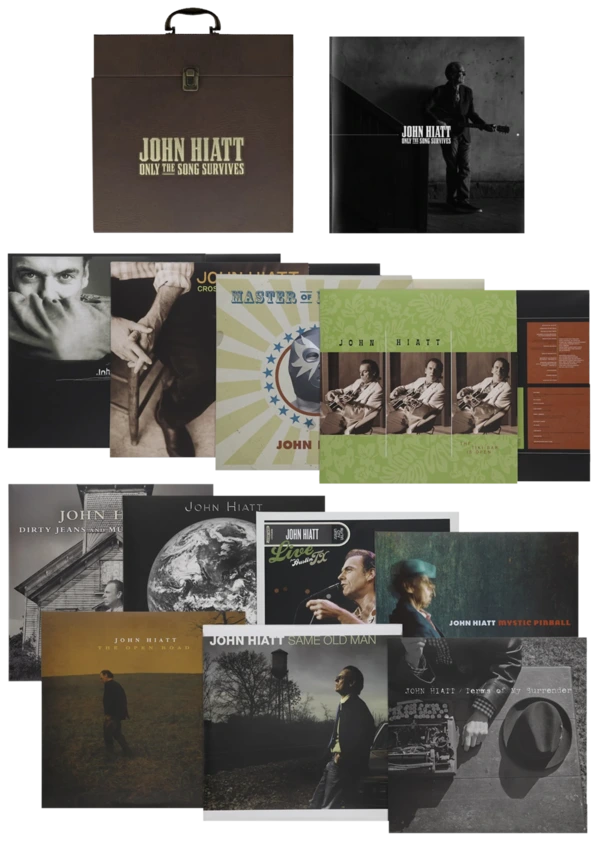
Saturday night, audience members will file into one of Hiatt's favorite halls, Nashville's historic Ryman Auditorium, and they'll witness a Hiatt set that will include longtime favorites such as "Tennessee Plates," "Thing Called Love" and "Have a Little Faith in Me" along with songs from a fine new album, Dirty Jeans and Mudslide Hymns. The new one is Hiatt's 20th studio album, and it stands with any of them.

To watch Hiatt these days is to wonder that he was ever a shoe-gazing folkie. These days, He prowls the stage, delivering the bluesy stuff in a whiskey-burn howl, shouting the rock stuff and fronting a formidable band that can turn on a dime, from ballads to bombast.

The new album opens with bombast, with a song called "Damn This Town," in which the sad sack narrator stews over his fate, proclaiming a noisy exit without ever going anywhere, bolted to the chair like Hiatt onstage before that Denver night. Hiatt burned that character out of his brain after coming up with an insistent guitar riff.

"I had that riff, and kept singing nonsense over it," he says. "The first line just popped out: 'They killed my brother in a poker game/ Damn this town, I'm leaving.' And that's all I needed to jump in and take a trip. Now, we've got conflict. The guy's restless and irritable and he's ready to blame everyone and everything, but he never leaves, for reasons we don't really know."

Hiatt has been that guy at times, but not in a long while. He's a settled kind of fellow; It has been a long time since his voice's whiskey burn involved actual whiskey. In his Nashville years, he has gone from wild-eyed young buck to esteemed elder.

"I think I got old, is what you're trying to say," he says to that notion. "There's really nothing to becoming an elder statesman. You just don't die, and you hang around."

You hang around with a flammable brain, and a peculiar state of being; you make yourself a moving target and you watch the whole thing get easier by the day.

Nothing to it.

Reach Peter Cooper at 615-259-8220 or pcooper@tennessean.com.


Get tickets for the The john hiatt and the combo/big head todd and the monsters dates by clicking here.

bht&jh


JOHN HIATT'S DIRTY JEANS AND MUDSLIDE HYMNS OUT AUGUST 2 ON NEW WEST RECORD

"…one of rock's most astute singer-songwriters of the last 40 years."––Los Angeles Times

dirty jeans and mudslide hymnsDirty Jeans and Mudslide Hymns, the new album from acclaimed musician and songwriter John Hiatt, will be released August 2 on New West Records. This is Hiatt's twentieth solo album and follows his acclaimed 2010 release, The Open Road, which the Los Angeles Times heralded as a, "bluesy, heartland-soaked musical excursion," while the Buffalo News declared it "a classic for the future." As an added bonus, a deluxe version of the album will be made available, which will include a special behind-the-scenes DVD, The Making of Dirty Jeans and Mudslide Hymns and 24/96 High Resolution audio mix of the entire album. Additionally, Hiatt will tour continuously in support of the record, including co-headling tours with Lyle Lovett and Big Head Todd and the Monsters. See the Tour dates for complete details.

Dirty Jeans and Mudslide Hymns was recorded at Ben's Studio in Nashville and was produced by Kevin Shirley (Led Zeppelin, Aerosmith, The Black Crowes). In addition to Hiatt, the album features Kenneth Blevins on drums and percussion, Doug Lancio on electric guitars, mandolin and Hammertone and Patrick O'Hearn on bass guitar. As a preview to fans, the album's opening track and first single, "Damn This Town," is currently available to stream on Hiatt's Facebook page.

John Hiatt's career as a performer and songwriter has spanned more than 30 years and his work has been covered by everyone from Bob Dylan, Eric Clapton, BB King, and Bonnie Raitt to Iggy Pop, Three Dog Night and The Neville Brothers. Hiatt began his solo career with the 1974 album Hangin' Around the Observatory. His landmark 1987 release Bring The Family received critical praise and was his first album to chart in the U.S. In 1993, Rhino Records released Love Gets Strange: The Songs of John Hiatt, which collected many of the cover versions of his songs that were recorded during the 80s and 90s. 2000's Crossing Muddy Waters was released to critical acclaim and was called "The most natural and relaxed John Hiatt album in years…" by All Music Guide. In 2008, Hiatt was inducted into the Nashville Songwriters Hall of Fame and was honored by the Americana Music Association with their prestigious "Lifetime Achievement in Songwriting Award."


john hiattCATCHING UP WITH... JOHN HIATT

From Paste Magazine online
Writer: Josh Jackson
Feature, Published online on 15 Apr 2008

There are a lot of things I've never done in life, but interviewing John Hiatt while wearing swim trunks is no longer on that list. Lying on the lido deck—yes, the lido deck—and sipping on some fruitilicious alcoholic concoction while our ship sailed back from Jamaica to Miami, it was easy to forget that I was here for work, and more specifically, that my work involved interviewing Hiatt. Hence my not having time to change.

We were both aboard the Cayamo cruise in the Western Caribbean. I'd seen him with Lyle Lovett wandering around that same lido deck the day before, and neither musician were attacked by adoring fans. But as deferential as his fellow cruisers were when they were off-duty, they were wildly enthusiastic once Hiatt took the stage. His 18th album, Same Old Man, is due out on May 27.

Paste: During your show, you said you don't know why you don't play your older songs. Is it good to hear folks call out for some of the songs from the ages?
Hiatt: Yeah, it's always good to hear folks call out songs because—I think I said it from the stage—you get in the habit of just playing the same things out of human nature. But yeah, it's great when they call the stuff out.

Paste: Is it nice to be able to have normal conversations with your fans that aren't rushed, to be able to gauge your fans a little bit more?
Hiatt: I think Lyle had the funniest take on it. He reckoned that the audience was the captive ones rather than the other way around, and I guess that's sort of true on this ship. You know, it's them that can't go home. I've done a couple of cruises. I did Delbert McClinton's cruise a couple of times. This is much bigger. But this has been great; it's run really well. The people that come on the cruise are clearly here for the music. It's been a lot of fun. And just getting to meet people, you know. I think people appreciate just seeing you as you are.

Paste: You just recorded a new album in your home in Nashville?
Hiatt: I did. I just finished a record in between tours over a six month period, so probably all total I worked on it maybe six or eight weeks. I had a bunch of equipment I'd collected over the years, and I took what used to be my old racecar shop/writing room and had a buddy of mine who knows about these things wire it all together. I started making a record in June with Kenny Blevins playing drums and Luther Dickinson playing guitar. And I got word of this bass player named Patrick O'Hearne, and turns out he lived just up the road in Fairview, Tenn. He used to play with Frank Zappa, and I didn't know he was even around, but he came up and played upright bass on most things and electric bass on a couple things.

Paste: So does that mean the racecar has been put out?
Hiatt: It has, unfortunately. I had a couple of back surgeries about two or three years ago now, which put me off it for awhile. I was cleared to go back and race it if I wanted to, but I just don't have time.

Paste: That's got to be very different, having your recording studio in your house where you can tinker with it.
Hiatt: You know, it's been great because, being a megalomaniac, I sort of took the time to teach myself how to actually work the damn thing. And in my crazy way I found no need for an engineer or a producer, so I just sort of wound up doing the whole thing, those jobs, myself. My friend Arthur who used to actually run Zappa's studio up in Laurel Canyon for many years, helped me learn my way around the various knobs and stuff. He's the guy that actually hooked up the studio, so he kind of showed me how to work stuff. I gave myself plenty of room and went through with it, and I was real happy with the way things came out.

Paste: And the record will be released by New West again.
Hiatt: [Yes.] I think the last three records we've done were with New West. I'm what they call a free agent, which has been a really great thing for me. It's been a nice way to work with the record companies. I did a couple with Vanguard in the early 'aughties,' as the British call them—that's this century—and then I switched and started putting them with New West a couple records back, and I've been very happy with them. And what we do is a lease deal, where they basically have the right to sell the record for a certain period of time, and I maintain ownership of the actual recordings. It's been great.

Paste: So, Same Old Man. Does that mean we shouldn't expect too much in the way of sort of stretching out…
Hiatt: Well, no. Actually, for me, I think it's a pretty stripped down record. It's pretty straight ahead. I think the vocals are way up front; it's all about me this record because I didn't have anybody to argue with basically. So it's vocals right up front, the song is front and center, and the backing is minimal.

Paste: After the album is released on May 27, will you tour with a full band?
Hiatt: Yeah, I think I'm going to get just a quartet together (two guitars, bass and drums), and it's probably going to lean more towards acoustic, as the record really does, although it rocks pretty hard.


Read about John's car collection at MotorTrend.com

john hiattJohn Hiatt's songs have been covered by artists such as Bob Dylan, Rosanne Cash, the Neville Brothers, Three Dog Night, and Bonnie Raitt, just to name a few. Hiatt was nominated for a Grammy 11 times, crossing several genres, and in this manic Interweb era of self-promotion and narcissism, he's pretty low key. He'd rather his music speak for him... read full article